
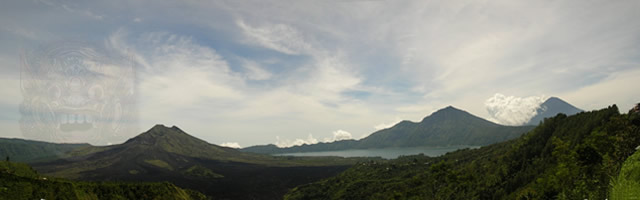
Batur Volcano history
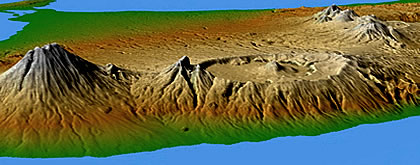
Around 23,000 BC during the cataclysms that marked the fore last shift of the earth’s poles, an explosion of incredible magnitude formed the gigantic Batur caldera which today has a diameter of ca. 13 km – one of the largest and most impressive in the world.
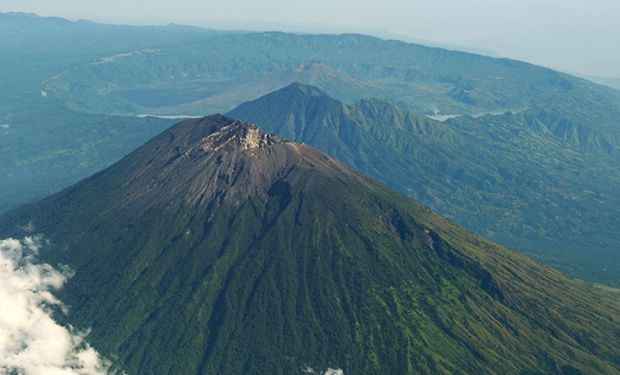
Before that eruption, Mt Batur rose about 3,800 m above sea level and it was thus higher than Mt Agung (3,142 m / 10,308 feet).
Click here for latest news on the eruption of mount Agung.
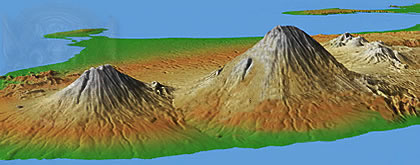
Another heavy eruption took place around 10,500 BC – at the time of the last shift of the earth’s poles – and formed a smaller, secondary crater with a diameter of ca. 7,5 km in the southeastern part of the larger caldera, nowadays marked by the Bali Aga villages of Songan and the popular panoramic viewpoint of Penelokan, with the current volcanic cone in its center.
The Batur caldera therefore actually consists of a gigantic, double elliptic crater with a total diameter of 10 x 13 km.
Contrary to for example the volcanoes of Hawaii, where the magma flows freely and accumulate gradually as spreading lava sheets, Indonesian magma’s move far less readily.
On reaching the surface, these slow-moving magma’s have enough time to cool and will periodically block release of the pent up forces beneath.
As the magma gets trapped this way, great reservoirs of liquid magma accumulate within the volcano, building up pressure until the earth can no longer contain it.
Without warning the top of the volcano gives way and the contained magma bursts forth with unimaginable violence.
With the passage of time the volcano, its core now emptied, slowly collapses back within itself to form a giant sunken crater or caldera.
Eventually, as fresh magma reaches the surface, new volcanic vents may appear within the caldera, slowly occluding it as discharged ash and lava gradually continue to accumulate.\r\n
Mount Batur today
Mt. Batur as we know it today was formed by an eruption in 1917; it is a still active, secondary volcanic cone sporting numerous subsidiary vents around its flanks. Measured from the floor of the crater it rises within the circling embrace of the caldera to a height of ca. 700 meter (1,717 meter / 5,633 feet above sea level).
The eruptions of Mt Batur have been registered since 1804 and since that time 22 eruptions of the volcano have occurred. Since 1917 Mt Batur erupted three more times (1926, 1974, 1994), on each occasion shifting a little more to the west, creating new sub craters that are referred to as Batur I, II and III respectively.
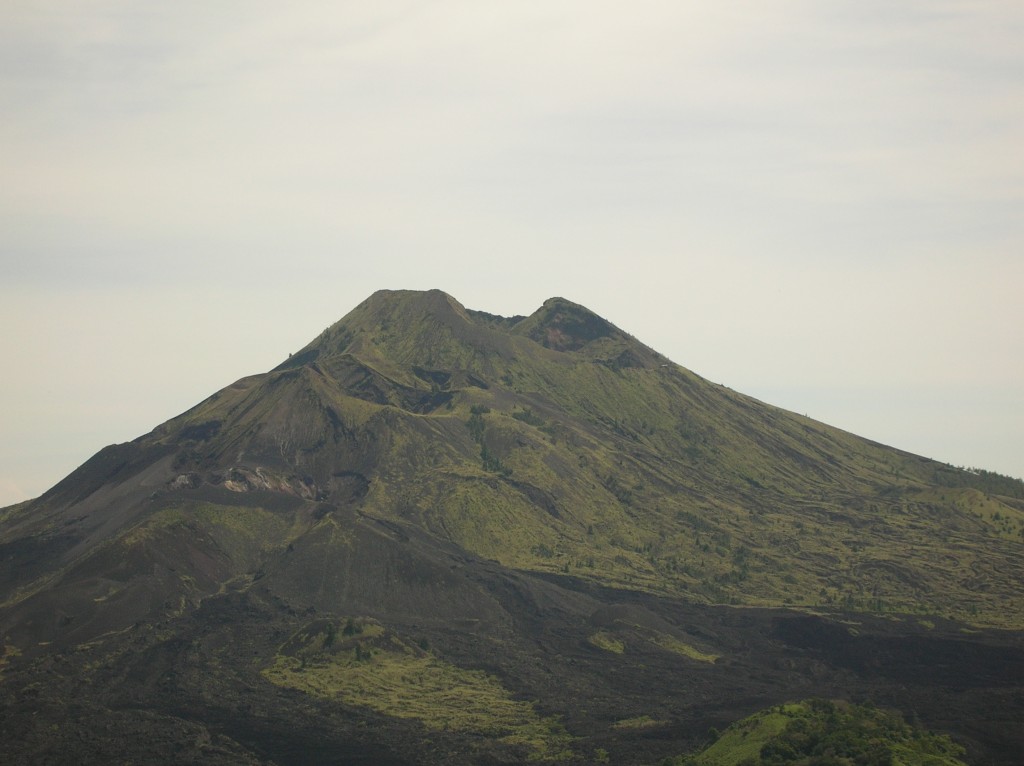
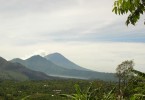
clearly visible Batur’s sub-craters and the black lava field of the 1994 eruption
As it grows through frequent minor (and occasionally not so minor!) eruptions it gradually enlarges its base at the expense of the lake, which is slowly shrinking in consequence.
With an altitude of 1,746 m Mt Penulisan forms the second highest point of the caldera rim; here one can find the mysterious Pura Tegeh Koripan, the highest and probably also the oldest temple of Bali.
Located secludedly in an isolated area along the eastern shore of lake Batur, at the foot of Mount Abang which is with an altitude of 2,152 meter (7,467 feet) the highest point of the caldera rim, one can find the Bali Aga village of Trunyan.
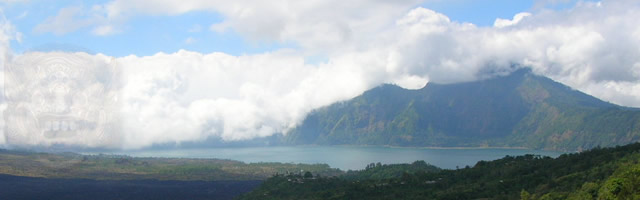
Lake Batur getting overcast
Lake Batur
Lake Batur is the largest lake of Bali. It is crescent shaped and it can be found in the smaller, secondary caldera of the Batur volcano, right at the foot of Mount Abang. Due to its height not only the temperature of the area is always cool but also the water of the lake.
To the local people who live in the small villages around lake Batur, the lake is a sacred site. The communities around the lake live mainly on agriculture and fishing and, in a lesser extent, on tourism.
share this article










[…] Mt Batur is an active volcano that is popular with hikers. (Wait, it’s active? I don’t remember that part!) There is not much else to do in this area besides hike the volcano and admire the view of a gorgeous green lake that lies below. What makes this hike memorable is recalling how foolish we were to have undertaken the hike as we did. […]
[…] Mt Batur is an active volcano that is popular with hikers. (It was inactive the day we visited!) It is a good day trip from Ubud but there was not much else to do here besides hike the volcano and admire the views of the gorgeous emerald green Lake Batur that lies below. […]